
An analog print shop
As the world becomes relentlessly digital, Woodspell is embracing the good work of doing things by hand.
-
Printmaking is a centuries old technique that was originally developed in China and later arrived in Europe to distribute information and images to the masses before printers existed.
There are many different forms of printmaking that utilize different materials from wood to linoleum, stencils, metal plates, and more. The process however remains similar. An image is carved or cut into a specific material and transferred to paper. This allows the same image to be reproduced many times without the use of technology.
-
The beauty of printmaking is that every print is an original. The block must be inked and printed for each piece. Because of this, there is no pixelation and every print is unique in its own way. The grain of the wood and the texture of the ink can be seen and felt throughout each print. This makes collecting original prints accessible without spending thousands of dollars.
-
As mentioned above, there are many different types of printmaking. I was immediately drawn to woodcut though for a few reasons. First, it is the original form of printmaking and truest to the medium. Second, as the plant person I am, I love working with woodblocks. Each type of wood is unique with a specific grain, knots, density. I personally reach for pine when carving most of my blocks. Because it comes with built in character within the grain and not a perfectly flat surface like other types of printmaking materials, it invites me to be in conversation with the woodblock as I carve. The image that is revealed is the work of both my hand and the wood.
-
Another beautiful thing about printmaking is that it allows me to use gorgeous handmade papers that simply cannot be used to reproduce digital prints. Paper making is an honored vocation in Japan and other countries. There are many types of paper created that come from various plants and shrubs, each with their own characteristics.
I usually reach for lokta paper which has been made high in the Himalayan foothills of Nepal for over a thousand years. It comes from the inner bark of a Daphne shrub, known locally as the lokta.
I prefer lokta paper because it is one of the most sustainable papers that can be made. While most handmade papers are nowhere near as harmful as mass producers of paper, I still want to tread as lightly as I can on this earth. Lokta paper also has the most gorgeous plant fiber inclusions throughout each sheet of paper. In a way it feels like the essence of the plant survives within the print.
-
Each print begins in nature. I sketch what I see and let it develop further. I like to then sketch directly onto the woodblock instead of transferring an image.
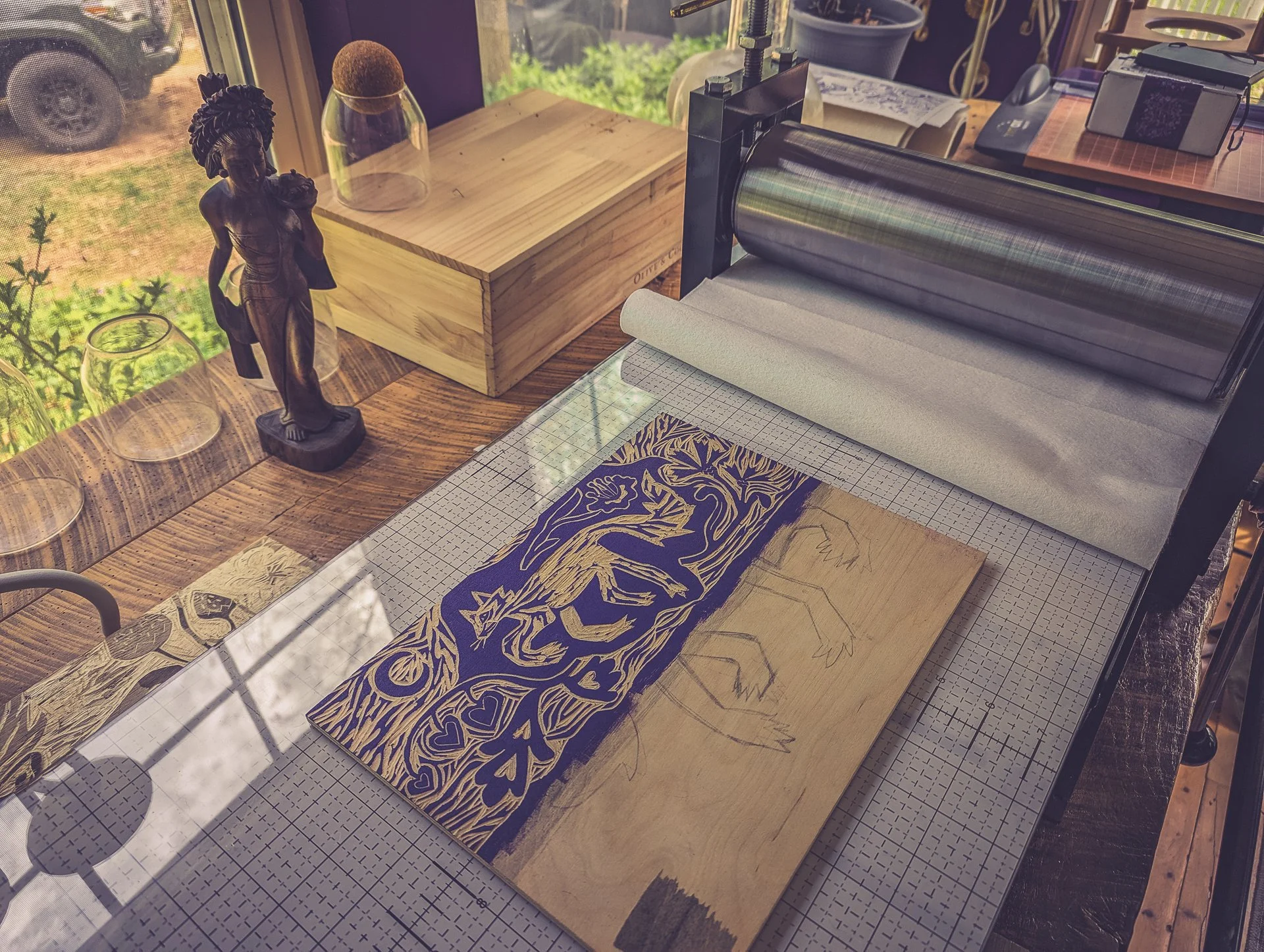
An image is carved into the wood using specialty gouges and knives. A woodblock is carved for each color used in the print.
Colors are then mixed using relief inks and rolled directly onto each woodblock.
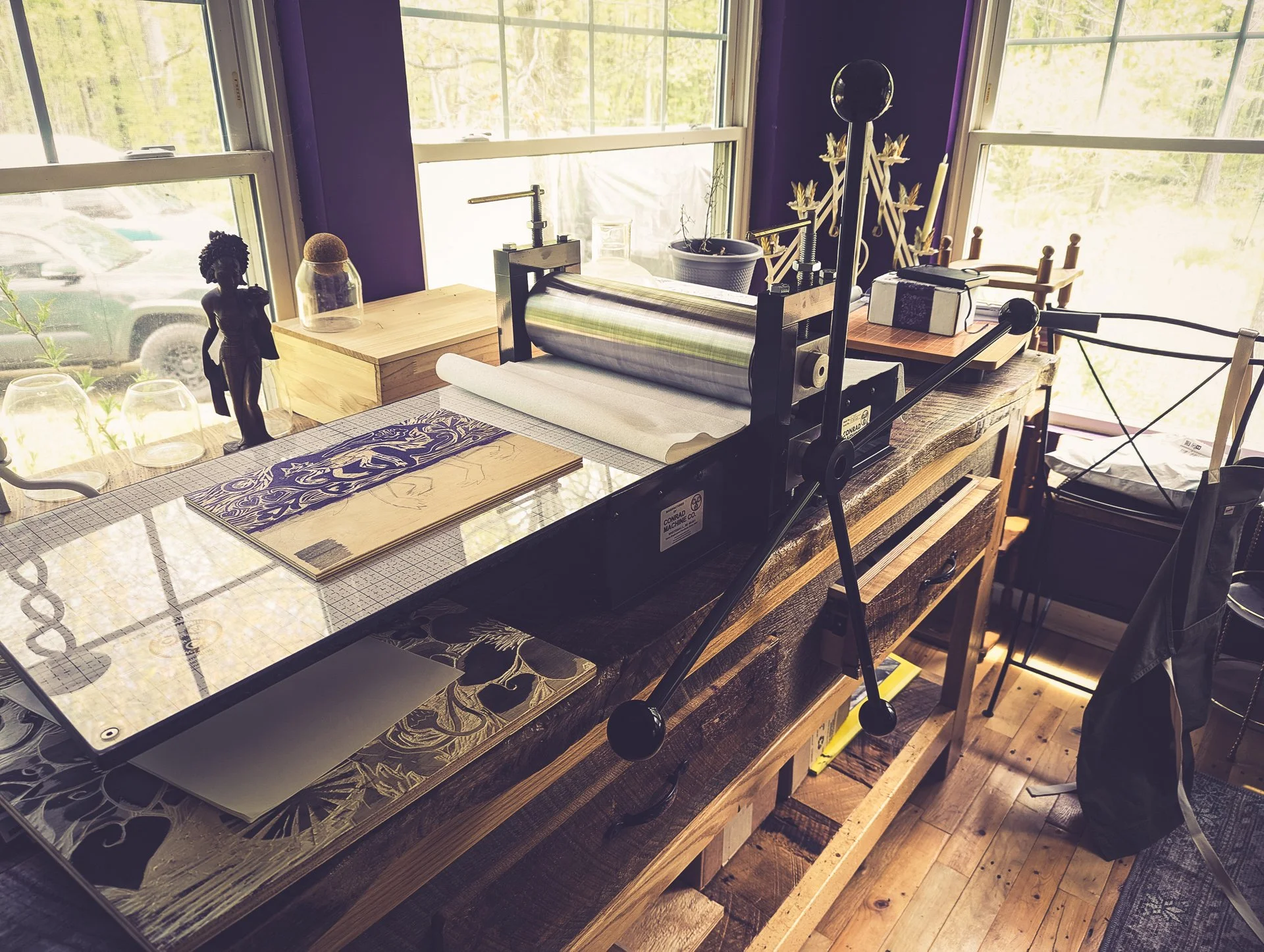
By now the paper is sized and registered so that it lays perfectly aligned onto the woodblock. Once the paper is aligned on top of the inked woodblock, it is run through my Conrad press.
The paper is ran through the press as many times as there are colors until the final image is revealed.
The paper is then hung to dry and stored in archival storage cubbies before it is shipped out.
-
Woodspell began as an herbal apothecary where I specialized in bitters and other remedies. Somewhere along the way, it became a production rather than a creation as my business grew. I decided to take a step back to reconnect with the plants and myself. Working with nature in a new way by getting back to my roots as an artist is what felt most authentic to me. This allows me to slow down, be present, and really hear what it is the world has to say.
Most of my herbal medicine making is done in my own kitchen now for my family and friends. I will offer small batches of remedies online from time to time (with the Woodswoman Salve being a permanent staple) as it feels right to put them out into the world.